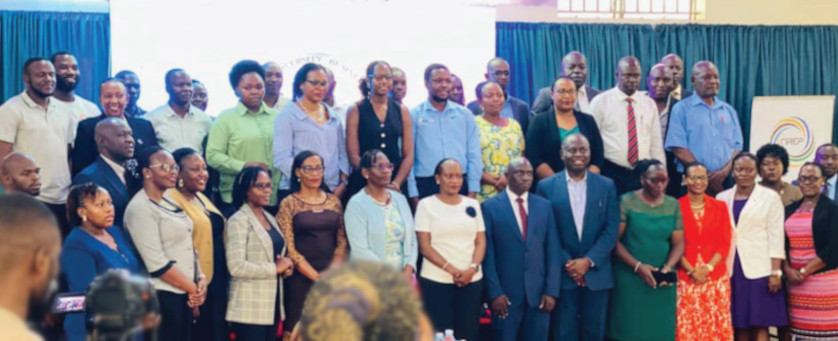
MUBS Ag. Deputy Principal, Assoc. Prof. Rachel Mindra Katoroogo, UBOS Deputy Executive Director Dr. Fred Senono and Participants pose for a group photo during the 2025 Energy Symposium at MUBS, held to showcase graduate contributions to Uganda’s clean energy transition
Ugandan graduates have been challenged to take a leading role in accelerating the country’s transition to clean and sustainable energy by transforming their academic research into practical solutions that influence policy, stimulate business innovation, and address community needs.
This call was made during the 2025 Energy Symposium held on Wednesday, November 12, 2025, at the Makerere University Business School (MUBS) main campus in Nakawa. The event, themed “Graduates in the Energy Space: Showcasing Contributions to Business, Policy and Research,” brought together academia, government representatives, private-sector players, and international partners from the Norwegian University of Life Sciences (NMBU), the University of Dar es Salaam, and the Norwegian University of Science and Technology (NTNU).
The symposium highlighted the growing contribution of MUBS graduates and researchers to Uganda’s clean energy transition, in line with Vision 2040 and the Sustainable Development Goals (SDGs)
“Graduate research is already producing practical business models that can be developed into market-ready products, particularly in the renewable energy sector. We need to ask how these insights can be applied to guide policies that reflect the needs of communities, businesses, and industries,”
Assoc. Prof. Mindra
MUBS Ag. Deputy Principal, Assoc. Prof. Rachel Mindra Katoroogo, emphasized the importance of data-driven decision-making, urging graduates to use their research to inform government and private-sector innovation. “Graduate research is already producing practical business models that can be developed into market-ready products, particularly in the renewable energy sector. We need to ask how these insights can be applied to guide policies that reflect the needs of communities, businesses, and industries,” she said. She noted that a wealth of research, ranging from models and recommendations to ongoing academic discussions is already available, and urged that these insights be used to guide ministry decisions and support the development of clean, affordable energy technologies.
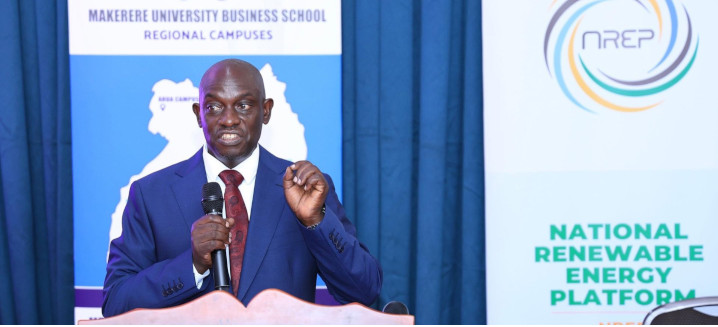
UBOS Deputy Executive Director Dr. Fred Senono delivers the keynote address at the 2025 MUBS Energy Symposium
Assoc. Prof. Mindra also highlighted MUBS’ expanding mandate, noting that the institution is broadening its focus beyond traditional business and management disciplines to contribute directly to Uganda’s long-term priorities, including Vision 2040 and the African Union Agenda 2063. Delivering the keynote address, Uganda Bureau of Statistics (UBOS) Deputy Executive Director, Dr. Fred Senono, called for stronger links between research and policymaking to ensure energy sector decisions are evidence-based.
He noted that UBOS is prioritizing the development of comprehensive energy and environmental statistics to better assess the sector’s contribution to Uganda’s GDP. “We are measuring how much energy contributes to our GDP. Without this information, investments in the sector cannot be properly guided,” Senono said. He added that UBOS is collaborating with the Danish Embassy to strengthen Uganda’s energy and environmental data systems.
The symposium also featured research presentations, exhibitions, and panel discussions designed to promote knowledge sharing, enhance collaboration across the energy ecosystem, and raise awareness of clean-cooking technologies and renewable energy innovations.
Organizers emphasized that the event underscores the growing need for graduates to apply innovation and evidence-based research to solve real-world challenges and support Uganda’s sustainable energy future.