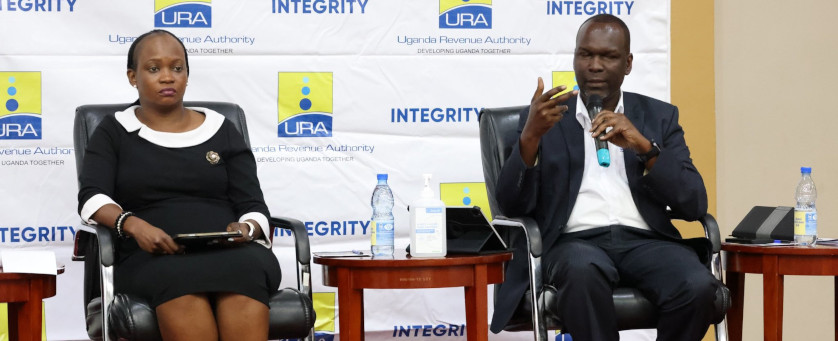
MUBS Ag. Deputy Principal Assoc. Prof. Rachel Mindra Katoroogo at the URA Commissioner General’s Integrity Forum
The Acting Deputy Principal Makerere University Business School (MUBS), Assoc. Prof. Rachel Mindra Katoroogo, represented the School at the Uganda Revenue Authority (URA) Commissioner General’s Integrity Forum held on 18 November 2025 at Hotel Africana, Kampala.
The high-level forum brought together senior government officials, private-sector leaders, business owners and development practitioners to reflect on the role of trust and integrity in strengthening tax administration and domestic revenue mobilization. Assoc. Prof. Mindra participated as a panelist in a session themed “Trust and Integrity in High-Value Taxpayer Engagement: A Development Finance Perspective,” reinforcing MUBS’ growing contribution to evidence-based national policy dialogue.
In her contribution, Assoc. Prof. Mindra underscored that integrity and trust are not abstract ideals but measurable determinants of tax system performance. Drawing on empirical research, she highlighted findings showing that strong integrity frameworks can improve tax compliance by 9–14 percent, while increased trust in tax authorities can boost compliance and taxpayer morale by up to 40 percent.
She emphasized that tax systems perform best when taxpayers perceive them as fair, predictable and consistently administered. “Trust is not a soft variable. It is a critical driver of compliance, investment confidence and institutional legitimacy. Where trust exists, voluntary compliance increases and enforcement costs decline,” she noted.
Assoc. Prof. Mindra identified predictability, policy stability and transparency as the most critical trust-building factors for high-value taxpayers. Predictability enables businesses to plan and forecast tax obligations over the long term, reducing uncertainty and supporting sustainable investment decisions. Policy stability minimizes compliance risks, while transparency enhances accountability and reduces opportunities for rent-seeking and corruption.
The forum also featured contributions from URA leadership and private-sector representatives, who echoed the need for stronger collaboration between revenue authorities, academia and the business community. Participants emphasized the importance of continuous dialogue, ethical leadership and data-driven policymaking in improving Uganda’s tax morale and strengthening the social contract between the state and taxpayers.
The Integrity Forum concluded with a collective call to deepen partnerships that promote rust, enhance service delivery, and support Uganda’s long-term domestic revenue goals.
The engagement further reaffirmed MUBS’ role as a strategic thought partner in advancing public sector reform, development finance and inclusive economic governance.