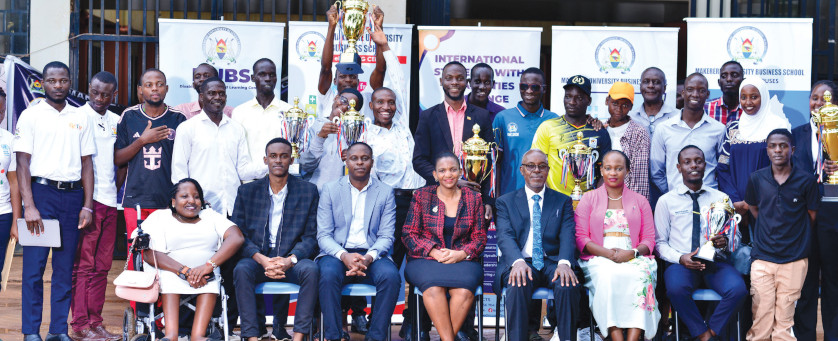
4th L-R Ms. Gorretti Byomiire, Mr. James Mwesigye, Assoc. Prof. Rachel Mindra Katoroogo in a group photo with participants at the Annual Disability Lecture
The Ugandan government is developing a National Artificial Intelligence Policy to guide responsible innovation, Dr. Frederick Kitoogo, Principal of the Uganda Institute of Information and Communications Technology (UICT), announced on Friday, November 14, 2025, at the MUBS Main Campus in Nakawa. Speaking at the Makerere University Business School (MUBS) Annual Disability Lecture, Dr. Kitoogo said the upcoming National AI Policy will help authorities ensure AI solutions are safe, ethical, and purposeful. He added that institutions must develop aligned AI policies, while eight new ICT Innovation Hubs are planned by 2027.
The lecture, held under the theme “AI for Tomorrow: Empowering Students for the Future Workforce,” also highlighted how technology can improve accessibility for students with disabilities.
Speaking at the event, Mr. James Mwesigye, Deputy Chairperson of the MUBS Council, highlighted how emerging technologies are breaking barriers for persons with disabilities, giving examples such as smart optical glasses that help visually impaired users detect objects and a Kenyan real-time sign language–to–speech system. MUBS Principal, Prof. Moses Muhwezi, announced new initiatives such as smart boards and inclusive walkways, and encouraged students with unseen disabilities to seek support, noting that upcoming student hostels are also being designed with disability inclusion in mind. “We are introducing smart boards to ensure everyone can read clearly,” Prof. Muhwezi said.
Assoc. Prof. Rachel Mindra Katoroogo, Acting Deputy Principal of MUBS, acknowledged ongoing accessibility challenges for students with disabilities and affirmed MUBS’commitment to fully inclusive future developments, aligned with Vision 2040 and the SDGs.
Ms. Goretti Byomire, Director of the Disability and Learning Centre, and MUBS Minister for Students with Disabilities, Mr. Allan Kiguli, urged students to build AI skills and use technology responsibly, highlighting the School’s commitment to inclusive education and preparing students with disabilities for a technology-driven workforce.